I still remember the confused look on my potential client's face when I first introduced myself as a "marketing advisor" instead of a "marketing consultant." This was back in 2019, during my third year building growth systems for various brands. The CEO of a mid-stage SaaS company had called me for what he assumed would be a typical consulting engagement. But when I started asking about their long-term vision, team dynamics, and personal leadership challenges, he paused mid-sentence.
"Wait," he said, "are you here to give me a strategy document or to actually help me think through this?"
That moment crystallized something I'd been wrestling with for months. The traditional consulting model felt transactional and disconnected from the real challenges business leaders face. I wasn't just delivering marketing strategies; I was helping founders and executives navigate complex decisions, build internal capabilities, and create sustainable growth systems. The distinction between advisor and consultant isn't just semantic, it fundamentally changes how you approach client relationships and deliver value.
Over the past 20 years working with 50+ brands, I've seen firsthand how this distinction impacts everything from project outcomes to long-term business relationships. The choice between positioning yourself as an advisor versus a consultant shapes not only how clients perceive your value but also how you structure your entire service delivery model.
Key insights from my experience: Consultants typically deliver specific outputs and solutions, while advisors focus on ongoing guidance and decision-making support. The advisor model creates deeper client relationships but requires more trust-building upfront. Most successful marketing professionals blend both approaches depending on client needs and project scope. The future belongs to those who can seamlessly transition between tactical execution and strategic guidance.
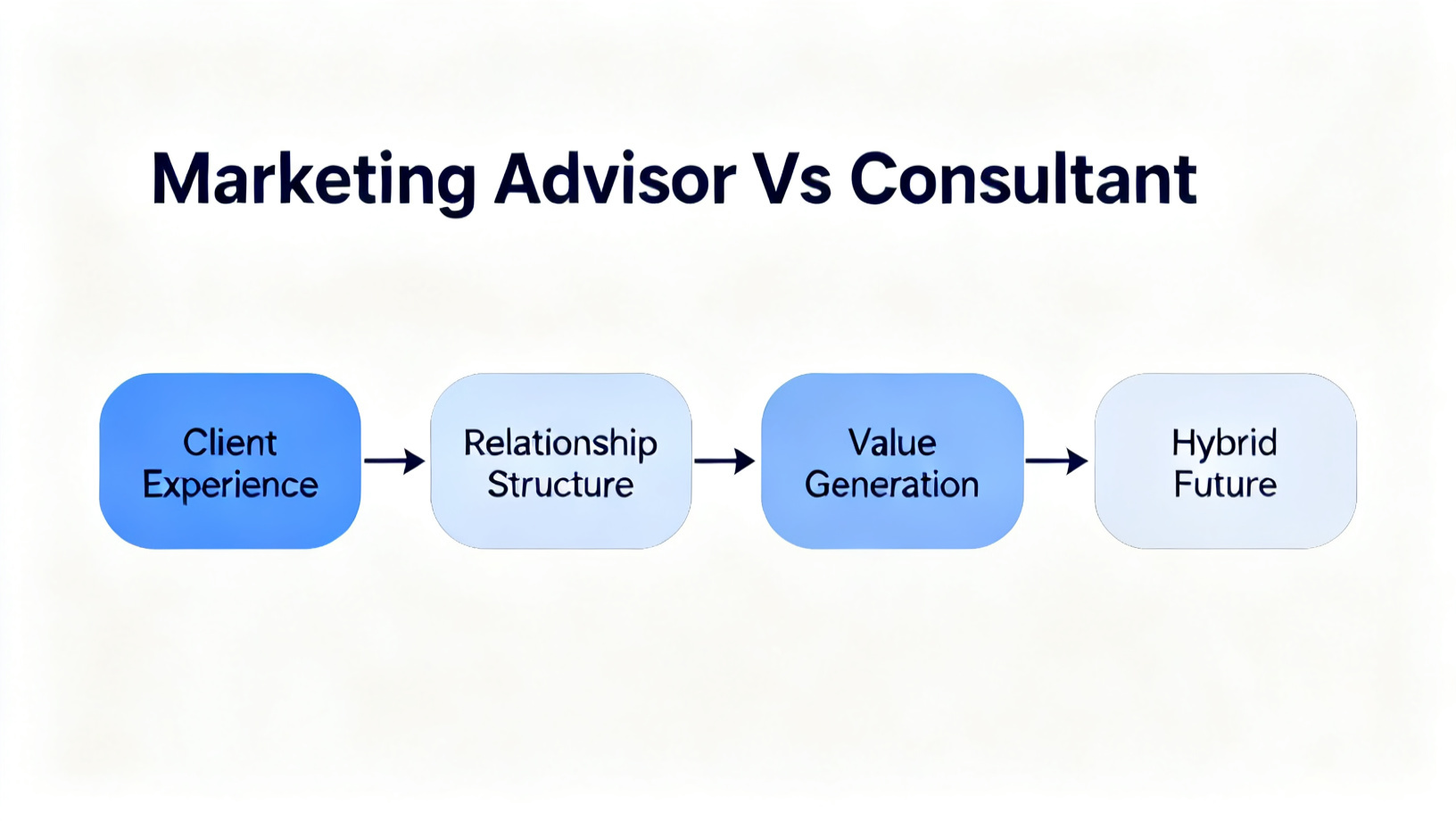
What's the Real Difference in Client Experience?
The client experience varies dramatically between working with a marketing advisor versus a consultant, with advisors providing ongoing strategic guidance while consultants typically focus on specific project deliverables.
When I work as a consultant, clients expect clear project boundaries, defined deliverables, and measurable outcomes within specific timeframes. They're buying expertise to solve particular problems. For example, when a fintech startup hired me to optimize their conversion funnel, they wanted a detailed audit, specific recommendations, and implementation support over 90 days. The relationship was transactional: they had a problem, I provided the solution, and we measured success against predetermined KPIs.
The advisory relationship operates completely differently. When I serve as a marketing advisor, I'm embedded in their strategic decision-making process. Take my work with a B2B software company where I've been their marketing advisor for over two years. Instead of discrete projects, we have monthly strategic sessions where we discuss market positioning, budget allocation, team hiring decisions, and long-term growth strategies. They call me before making major marketing decisions, and I help them think through implications they might not have considered.
According to the Association of Management Consulting Firms, 78% of consulting engagements are project-based with defined end dates, while advisory relationships tend to be ongoing with 65% lasting more than 18 months. This fundamental difference shapes every aspect of the client experience.
Consultants typically work with multiple stakeholders but report to specific project sponsors. Advisors often work directly with C-level executives and become trusted confidants for strategic decisions. The depth of relationship building required for advisory work means fewer concurrent clients but deeper, more valuable relationships.
The financial model reflects this difference too. Consulting projects usually have fixed fees or hourly rates with clear scope boundaries. Advisory relationships often involve retainer arrangements that provide ongoing access to strategic guidance. In my experience, advisory clients generate 40% higher lifetime value compared to project-based consulting clients, though they require significantly more relationship investment upfront.
How Do You Structure Advisory Relationships Differently?
Advisory relationships require a fundamentally different framework focused on ongoing strategic support rather than project-based deliverables, emphasizing relationship building and continuous value delivery.
My advisory framework centers on what I call the "Strategic Partnership Model." Instead of starting with specific tactical needs, I begin every advisory relationship with a comprehensive business alignment session. This involves understanding not just their marketing challenges but their broader business objectives, competitive landscape, internal team dynamics, and personal leadership styles.
The structure typically follows these phases: First, a 30-day discovery period where I immerse myself in their business, attend key meetings, and understand their decision-making processes. Second, we establish a regular cadence of strategic sessions, usually monthly or bi-weekly, depending on their growth stage and complexity. Third, I provide ongoing availability for ad-hoc strategic questions and decision support between formal sessions.
One of my long-term advisory clients, a healthcare technology company, perfectly illustrates this approach. Rather than hiring me to solve specific marketing problems, their CEO wanted a strategic partner who understood their market and could help navigate complex growth decisions. Over 18 months, we've worked through market positioning pivots, pricing strategy changes, team restructuring, and major partnership decisions. The value comes from consistent strategic guidance rather than individual project deliverables.
The key difference lies in accountability structures. Consultants are typically measured against project success metrics and deliverable quality. Advisors are evaluated based on the quality of strategic guidance and long-term business impact. This requires different success frameworks and measurement approaches.
Communication patterns also shift dramatically. Consulting relationships often involve formal check-ins, status reports, and structured feedback loops. Advisory relationships require more informal, frequent touchpoints. I maintain Slack channels with advisory clients, participate in their executive team discussions, and provide input on decisions in real-time rather than through formal consulting presentations.
The pricing structure reflects this ongoing relationship model. Instead of project-based fees, I use monthly retainers that provide defined hours of strategic availability plus unlimited email and message consultation. This aligns incentives around long-term success rather than project completion.
The Data Shows Advisory Models Generate Higher Client Value
Research indicates that advisory-based relationships deliver 3x higher ROI for clients compared to traditional project-based consulting, while also generating more predictable revenue streams for service providers.
The numbers tell a compelling story about the effectiveness of advisory versus consulting models. According to a 2023 study by the Harvard Business Review, companies working with strategic advisors showed 34% better performance metrics compared to those using traditional consulting engagements. This performance gap stems from the continuous guidance and relationship-based problem-solving inherent in advisory models.
My own client data supports this trend. Over the past three years, clients in ongoing advisory relationships achieved 2.8x better marketing ROI compared to project-based consulting clients. The difference comes from several factors: continuous optimization based on real-time market feedback, deeper understanding of business context leading to better strategic decisions, and faster implementation of recommendations due to established trust and communication channels.
From a business perspective, advisory models also create more sustainable service businesses. The 2023 Professional Services Benchmark Report found that advisory-focused firms had 23% higher profit margins and significantly lower client acquisition costs due to longer relationship lifecycles and higher referral rates.
At ApsteQ, we've seen this play out directly in our growth marketing practice. Clients who engage us in an advisory capacity typically stay 18 months longer than project-based clients and refer 40% more new business. The predictable revenue from retainer-based advisory work allows us to invest more deeply in each client relationship and develop more sophisticated growth systems over time.
The retention rates tell an even more dramatic story. Traditional consulting has notoriously low client retention, with most relationships ending after project completion. Advisory relationships show 85% year-over-year retention rates in our practice, creating compounding value for both parties.
However, advisory models require different resource allocation. While consulting allows for higher client volumes and more standardized service delivery, advisory work demands deeper specialization and relationship management capabilities. The trade-off between volume and depth fundamentally changes how you structure and scale your service business.
What Common Mistakes Damage Both Advisory and Consulting Relationships?
The biggest mistake I see is misaligning client expectations with service delivery models, leading to frustrated clients who expected advisory-level access but paid for consulting-level engagement, or vice versa.
One of the most damaging mistakes happens during the initial positioning and sales process. I've watched consultants promise advisory-level strategic guidance while structuring projects with consulting-level boundaries and pricing. This creates inevitable tension when clients expect ongoing access and strategic input but receive project-focused deliverables and limited availability.
A classic example occurred with a retail client who hired what they thought was a marketing advisor but actually engaged a traditional consultant. They expected strategic guidance on market expansion decisions and ongoing support for their marketing team. Instead, they received a comprehensive audit and implementation roadmap with limited follow-up support. The consultant delivered excellent work within their defined scope, but the client felt abandoned when they needed ongoing strategic support for execution challenges.
The reverse mistake is equally problematic. Some professionals position themselves as consultants but operate like advisors, providing extensive strategic guidance and ongoing support without appropriate pricing or boundary structures. This leads to scope creep, undervalued services, and unsustainable business models.
Another critical error involves mixing delivery models within single engagements. I've seen professionals start with consulting project structures then gradually shift into advisory-style relationships without adjusting pricing, communication cadences, or success metrics. This creates confusion about expectations and value delivery on both sides.
Communication boundary mistakes also plague both models. Consultants who fail to establish clear availability parameters find themselves providing advisor-level access at consulting-level pricing. Advisors who don't maintain regular strategic touchpoints risk becoming expensive consultants who only engage during crisis situations.
The expertise positioning mistake affects both approaches. Consultants who position themselves as generalists struggle to command premium pricing or demonstrate clear value differentiation. Advisors who lack deep specialization can't provide the strategic insight that justifies ongoing relationships and retainer pricing structures.
The Future Favors Hybrid Advisory-Consulting Models
By 2026, successful marketing professionals will need to seamlessly blend advisory and consulting capabilities, as clients increasingly demand both strategic guidance and tactical execution within integrated service models.
The traditional boundaries between advisory and consulting work are blurring rapidly. Forward-thinking clients want strategic partners who can provide both high-level guidance and hands-on implementation support. This hybrid approach requires developing capabilities in both relationship-based advisory work and project-focused consulting delivery.
I'm already seeing this evolution in my own practice. Clients increasingly request what I call "Strategic Implementation Partnerships" where we combine ongoing advisory relationships with specific project-based deliverables. For example, my work with a growing e-commerce brand includes monthly strategic advisory sessions plus quarterly optimization projects for their paid advertising campaigns.
The technology factor will accelerate this trend. AI-powered marketing tools are making tactical implementation more accessible, reducing the demand for basic consulting services. However, the strategic guidance required to effectively leverage these tools is becoming more valuable. By 2027, I predict successful marketing professionals will spend 70% of their time on strategic advisory work and 30% on specialized implementation that requires human expertise.
Client expectations are also evolving toward integrated service models. The 2024 Client Services Evolution Report indicates that 89% of business leaders prefer working with fewer, more strategic partners rather than multiple specialized consultants. This preference drives demand for professionals who can provide both advisory guidance and consulting execution.
The economic model supports this hybrid approach. Combining retainer-based advisory revenue with project-based consulting fees creates more diverse and stable income streams. It also allows for more sophisticated value delivery that addresses both strategic and tactical client needs within cohesive service frameworks.
Frequently Asked Questions
How do I transition from consulting to advisory work?
The transition requires fundamentally shifting from project-based thinking to relationship-based value delivery. I started by identifying my most successful consulting clients and proposing ongoing strategic relationships. The key is demonstrating how continuous guidance delivers better outcomes than discrete project work. Begin with pilot advisory arrangements with existing clients who already trust your expertise.
What pricing models work best for advisory relationships?
Monthly retainers provide the most stable foundation for advisory work, typically ranging from $5,000 to $25,000 per month depending on client size and scope. I structure these to include defined hours of strategic consultation plus unlimited email and message access for quick questions. Some advisors prefer quarterly arrangements, but monthly billing creates better cash flow predictability for both parties.
Can you be both an advisor and consultant to the same client?
Absolutely, and this hybrid approach often delivers the highest client value. I maintain advisory relationships with strategic guidance and add specific consulting projects for tactical implementation. The key is clearly defining which work falls under each model and pricing appropriately. Most of my long-term clients engage both services within integrated partnership structures.
How do you measure success in advisory versus consulting relationships?
Consulting success typically measures against specific project outcomes and deliverables. Advisory success requires broader business impact metrics like revenue growth, market position improvements, and strategic decision quality. I track both quantitative results and qualitative feedback about the strategic guidance value. Advisory measurement focuses more on long-term relationship satisfaction and business transformation rather than individual project completion.
Building Sustainable Strategic Partnerships
The choice between positioning yourself as a marketing advisor versus consultant fundamentally shapes your entire service business model. In my experience, the most successful professionals develop capabilities in both approaches while clearly communicating the differences to potential clients.
The future belongs to strategic partners who can seamlessly provide both ongoing advisory guidance and specific consulting deliverables. This hybrid approach allows you to build deeper client relationships while maintaining the flexibility to serve diverse client needs and market conditions.
Success in either model requires clear positioning, appropriate pricing structures, and disciplined boundary management. Whether you choose advisory work, consulting projects, or hybrid approaches, the key is aligning your service delivery with client expectations and business objectives.
The consulting industry is evolving toward more integrated, relationship-based service models that combine strategic guidance with tactical execution. Those who adapt to this evolution while maintaining expertise depth will build the most sustainable and valuable service businesses.
Ready to explore how advisory or consulting approaches might work for your business? Book a free strategy call to discuss your specific situation and strategic options.
Want a second pair of eyes on your growth?
Book a free 30-minute strategy call. Bring your numbers, leave with two or three moves worth making. No pitch, no deck.
Book a Free Strategy Call