The Day I Realized I'd Been Calling Myself the Wrong Thing
About eight years into my career, a CFO at a mid-sized SaaS company pulled me aside after a board meeting and said something that stopped me cold: "Arsh, I hired you as a consultant, but you've been acting like my advisor. I'm not sure that's what I need right now." I had no idea what she meant. I thought those words were interchangeable, two labels for the same type of smart person who helps businesses grow. I was wrong, and that conversation cost me the engagement. Over the next six months, I dug into the actual difference, interviewed dozens of clients across industries, and rebuilt how I positioned every engagement. What I discovered changed how I run ApsteQ entirely. The distinction between an advisor and a consultant is not semantic. It is structural, relational, and deeply consequential for both the professional and the client.
Key Takeaways Before You Read On:
- Advisors provide ongoing strategic guidance within a relationship; consultants deliver defined project-based outcomes. Confusing the two creates misaligned expectations on both sides.
- 76% of executives report that engagements fail not due to poor advice, but due to misaligned scope and role definition (Harvard Business Review, 2022).
- The consulting industry is projected to reach $1.3 trillion globally by 2026, with advisory services growing at nearly double the rate of traditional project consulting (Statista, 2023).
- Choosing the wrong engagement model is one of the top three reasons businesses waste budget on external expertise, according to a study of 500+ firms (McKinsey, 2021).
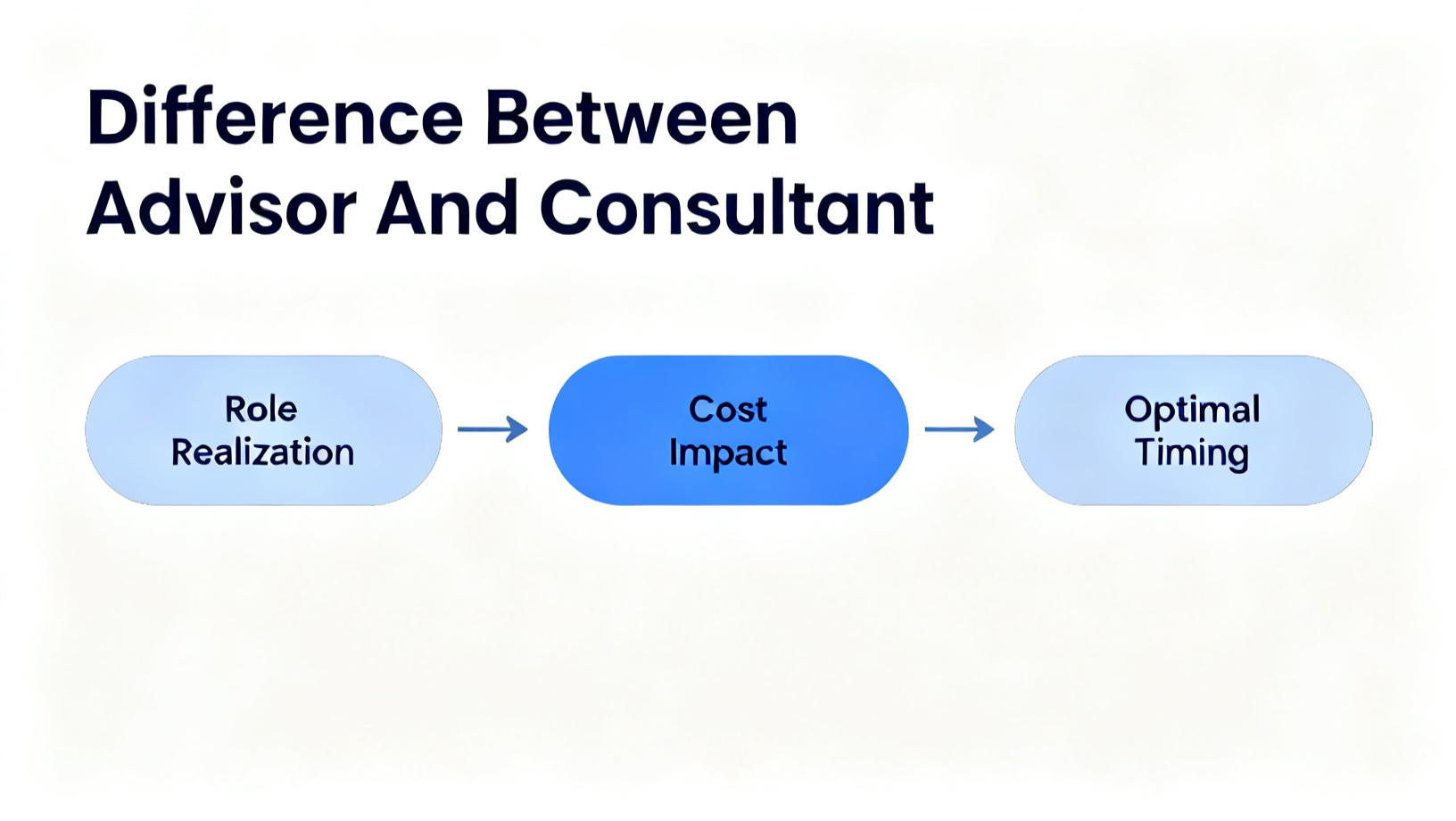
What Does the Client Actually Experience When Working With an Advisor Versus a Consultant?
The client experience is fundamentally different depending on whether they have engaged an advisor or a consultant, and most clients do not realize this until something goes wrong. An advisor is a long-term thinking partner; a consultant is a short-to-medium-term problem solver. Both are valuable, but they serve different moments in a company's lifecycle.
When a client works with a consultant, they typically bring a defined problem, expect a deliverable, and measure success by whether that deliverable was produced on time and on budget. Think of a brand strategy deck, a go-to-market plan, or a marketing audit. The engagement has a start and end date. The consultant comes in, assesses the situation, applies a framework, and exits. The relationship is transactional in structure, even if it is warm in tone.
An advisor, on the other hand, operates inside an ongoing relationship. The client does not always know exactly what they need when they call their advisor. They might say, "We're thinking about entering a new market," or "Our churn spiked last quarter and I'm not sure why." The advisor helps them think through the problem before any solution is even considered. The value is not in a deliverable; it is in judgment developed over time with deep context about the client's business.
I have seen this play out with hundreds of clients. One e-commerce brand hired me as a consultant to audit their paid media performance. I found the issues, wrote the report, made the recommendations. Engagement over. Eighteen months later, they called me in a panic because their CAC had tripled. They didn't need another audit; they needed someone who had been in the room with them all along. That's when we shifted to an advisory retainer, and it made all the difference.
The data backs this up. Research from Harvard Business Review (2022) shows that 76% of executives say their external engagements fall short not because the expert lacked knowledge, but because the scope and role were poorly defined from day one. Meanwhile, Gartner found that companies with long-term advisory relationships retain strategic alignment 2.3 times more effectively than those relying solely on project-based consultants (Gartner, 2021).
From a client perspective, the simplest test is this: if you know the question, you need a consultant. If you're still figuring out the question, you need an advisor.
How Do You Choose the Right Engagement Model for Your Business Situation?
Choosing between an advisor and a consultant comes down to a structured self-assessment of your business situation, specifically around clarity, timeline, and the nature of the problem you are facing. I use a four-step framework with every prospective client before we agree on an engagement structure.
Step 1: Define the Problem Clarity Level
Rate your problem clarity on a scale of one to ten. If you score a seven or above, meaning you can articulate the problem, the desired outcome, and the constraints clearly, a consultant is likely the right fit. If you score below a seven, you are in ambiguity, and an advisor who can help you structure your thinking will serve you better than someone who jumps straight to solutions.
Step 2: Identify the Timeline and Urgency
Consultants thrive in time-bound engagements. If you have a product launch in 90 days or a board presentation in six weeks, you need someone who can sprint with you. Advisors add the most value over quarters and years. A startup founder building their first growth engine does not need a three-month sprint consultant; they need someone in their corner for 18 months as the strategy evolves.
Step 3: Assess Internal Execution Capacity
One mistake I see constantly: companies hire consultants when they actually need advisors, because they assume consultants will "do more." In reality, most consultants advise and recommend; they rarely execute. If your team lacks the capacity to implement recommendations, you need either an embedded consultant who executes, or an advisor who helps you build internal capacity over time.
Step 4: Evaluate the Relationship Dependency
Ask yourself: do I need someone who understands my industry in general, or someone who understands my business specifically? Consultants bring external best practices and benchmarks. Advisors bring accumulated context about your specific situation. A fintech client I worked with for three years made better decisions in year three not because I was smarter, but because I had three years of context on their market, team dynamics, and strategic history.
"The best advisory relationships are not about expertise alone. They are about accumulated context. An advisor who knows your business deeply will outperform a brilliant consultant who is seeing it for the first time."
At ApsteQ, we have formalized this framework into our intake process so every client starts in the right structure from day one. It is one of the single biggest improvements we made to our client success rates.
The Data Behind Why Role Confusion Costs Businesses Serious Money
Role confusion between advisors and consultants is not just an abstract problem. It carries a measurable financial cost, and the numbers are more alarming than most business owners realize.
Let me start with a number that genuinely surprised me when I first came across it. McKinsey's 2021 research on external expertise utilization found that 47% of companies reported wasting more than 30% of their consulting budget due to misaligned engagement structures (McKinsey, 2021). That is not wasted due to bad advice. That is wasted because the wrong type of person was hired for the wrong type of problem.
The second data point I return to constantly comes from MIT Sloan. Their research found that organizations that clearly distinguish between advisory and consulting functions in their vendor relationships achieve 34% higher ROI on external expertise spend (MIT Sloan Management Review, 2022). The mechanism is simple: when both parties know exactly what role they are playing, there is less scope creep, fewer expectation mismatches, and cleaner handoffs to internal teams.
Third, the growth trajectory of advisory services tells an important story. According to Statista, the global management consulting market is projected to hit $1.3 trillion by 2026, with advisory retainer models growing at roughly twice the rate of traditional project-based consulting engagements (Statista, 2023). Clients are voting with their budgets. They are migrating toward ongoing advisory relationships because they have experienced the cost of one-off engagements that do not sustain results.
At ApsteQ, I have tracked this shift in real time. In 2020, roughly 60% of our client engagements were project-based. By 2024, that ratio had flipped, with advisory retainers now representing more than 65% of our revenue. Clients are not just more satisfied with advisory relationships; they stay longer and generate better business outcomes.
Forbes Insights documented a related pattern in their 2022 report on strategic advisory services: companies that maintain at least one long-term advisor relationship are 2.1 times more likely to achieve their annual strategic objectives than those relying exclusively on project consultants (Forbes Insights, 2022). That correlation is not coincidental. Long-term advisors become institutionalized knowledge, something a consultant hired for a 10-week sprint can never replicate.
The financial case for understanding this distinction is overwhelming. Getting it wrong is not just an operational inconvenience; it is a measurable drag on business performance.
What Are the Most Common Mistakes People Make When Hiring Advisors or Consultants?
The most common mistakes happen before the engagement even begins, usually in how the role is defined and what success looks like. After working with more than 300 brands at ApsteQ, I have seen the same errors repeat with painful consistency.
Mistake 1: Hiring a Consultant When You Need Thinking Time
I see this constantly with early-stage founders. They are not sure of their direction, they have not validated their core assumptions, and they hire a consultant expecting deliverables that will resolve their uncertainty. The consultant produces a beautiful strategy document. The founder feels no clearer. That is not the consultant's failure; it is a model mismatch. What the founder needed was an advisor to sit with them for three months and help them develop strategic clarity first.
Mistake 2: Treating an Advisor Like a Consultant
The inverse happens in more established companies. A growth-stage business brings on a respected industry advisor, then immediately asks them to produce weekly deliverables, sit in on operational meetings, and manage vendor relationships. That is consultant work. Advisors who are pulled into execution mode lose the strategic altitude that makes them valuable. I once watched a fantastic advisor relationship collapse because the client kept dragging their advisor into vendor negotiations instead of using those sessions for scenario planning and high-level decision support.
Mistake 3: Skipping the Scope Definition Conversation
In a rush to get started, many clients and consultants alike skip the foundational conversation about role clarity. What does success look like in 90 days? Who owns implementation? How will we measure the value of strategic guidance versus tactical output? When these questions go unanswered at the start, they resurface as conflicts and scope creep three months in. I now spend a full session with every new client just on role and expectation alignment before any work begins.
Mistake 4: Assuming Credentials Define the Role
Someone with "advisor" in their title is not automatically functioning as an advisor, and vice versa. I have met people with senior consulting titles who functioned entirely as long-term thinking partners, and self-described advisors who were really doing tactical project work. The title does not define the engagement model. The structure of the work, the timeline, the deliverables, and the relationship depth do.
Mistake 5: Failing to Re-evaluate the Model Over Time
Business needs evolve. A company that needed a consultant to build their first marketing infrastructure two years ago may now need an advisor to guide their next phase of strategic growth. Staying locked in the original engagement model out of habit or convenience is a real cost. I review the engagement model with every long-term client at least once per year to make sure we are still in the right structure for where they are.
How Will the Advisor and Consultant Landscape Evolve Through 2026 and 2027?
The line between advisors and consultants is going to get more interesting, not less, over the next two years. Several converging forces are reshaping how businesses use external expertise, and the professionals who understand these shifts will be positioned well.
First, AI-augmented consulting is compressing project timelines dramatically. Work that once took a consultant six weeks to deliver, a competitive analysis, a channel audit, a segmentation model, can now be produced in days using the right AI systems. This means the traditional project-based consulting model faces real pricing pressure. The value proposition shifts toward judgment, relationships, and strategic context, which are the core strengths of advisory relationships. I expect we will see a significant portion of mid-tier consulting firms pivot toward advisory retainer models by 2027 simply to defend their margins.
Second, Gartner predicts that by 2026, more than 60% of B2B service engagements will include some form of embedded AI-assisted analysis as a standard component (Gartner, 2023). This changes the consultant's role from analyst to interpreter. The human value-add becomes less about gathering and organizing information and more about applying judgment to AI-generated insights. That is precisely the skill set that advisors have always operated from.
Third, I believe we will see the rise of what I call the "fractional advisor," an experienced strategic mind who works with five to ten companies simultaneously in a high-touch advisory capacity. This model already exists in CFO and CMO roles, but it will expand into growth strategy, AI integration, and market positioning. Businesses that cannot afford a full-time strategic executive will increasingly turn to fractional advisors as a cost-effective alternative to traditional consulting retainers.
For businesses planning their external expertise budgets for 2026 and 2027, my strong recommendation is to evaluate whether your current mix of advisors and consultants reflects where your strategic needs are heading, not where they have been.
The Consultant Toolkit
Effective consulting requires visibility into client data. We use Supabase for client dashboards, n8n for follow-up automation, and Google Ads/Meta for campaign management consultation. The tools do not define the consultant. The ability to extract signal from data and recommend specific changes does.
Frequently Asked Questions
What is the simplest way to explain the difference between an advisor and a consultant?
A consultant is hired to solve a specific problem within a defined timeframe and produces a tangible deliverable. An advisor is engaged for ongoing strategic guidance within a longer-term relationship, with value coming from accumulated context and judgment rather than project outputs. If you know the question clearly, hire a consultant. If you are still figuring out the right question, hire an advisor.
Can the same person serve as both an advisor and a consultant to the same client?
Yes, but it requires clear structure and discipline. I have done both for certain long-term clients, typically starting as a consultant on a specific project, then transitioning into an advisory relationship once deep trust and context are established. The risk is role blurring, where the advisor gets pulled into tactical consultant work and loses strategic altitude. Explicit agreements about which mode you are operating in at any given time are essential.
How do you typically price advisory versus consulting engagements?
Consulting engagements are usually priced by project scope, deliverable, or time-bound retainer. Advisory relationships are most often structured as monthly retainers tied to access and ongoing strategic support rather than specific deliverables. In my experience, advisory retainers are often underpriced relative to their actual value because the impact is harder to measure in the short term, but the long-term ROI tends to far exceed project-based consulting fees.
How long should an advisory relationship typically last?
There is no universal rule, but I rarely see advisory relationships deliver their full value in under 12 months. The compounding returns come from context accumulated over time. My most valuable advisory relationships have run three to five years. That said, I always recommend a structured 90-day evaluation at the start to confirm the relationship is producing genuine strategic value before committing to a longer arrangement.
Is the difference between advisor and consultant relevant for small businesses, or is this mostly for enterprise clients?
This distinction matters at every business size, arguably more so for small businesses where budget is limited and every external engagement must count. A small business owner who hires a consultant when they actually need an advisor, or vice versa, feels the financial and strategic cost more acutely than an enterprise with a large vendor budget. Getting the engagement model right from the start is a small business survival skill, not just an enterprise optimization.
The Right Role at the Right Moment Changes Everything
The difference between an advisor and a consultant is not about seniority, prestige, or even expertise. It is about alignment between what a business needs at a specific moment and the engagement model being used to address that need. Get it right, and external expertise becomes a genuine strategic multiplier. Get it wrong, and you are paying for deliverables that do not move the needle, or for advice that arrives too late to change the outcome.
After 20 years and more than 300 brand engagements, I have come to believe that this single distinction, advisor versus consultant, is one of the most underrated leverage points in business strategy. It is not glamorous, but it is foundational.
If you are unsure which type of engagement your business actually needs right now, I am happy to think through it with you. Book a free strategy call and we will figure out the right structure together before you spend a dollar on the wrong model.
Want a second pair of eyes on your growth?
Book a free 30-minute strategy call. Bring your numbers, leave with two or three moves worth making. No pitch, no deck.
Book a Free Strategy Call